
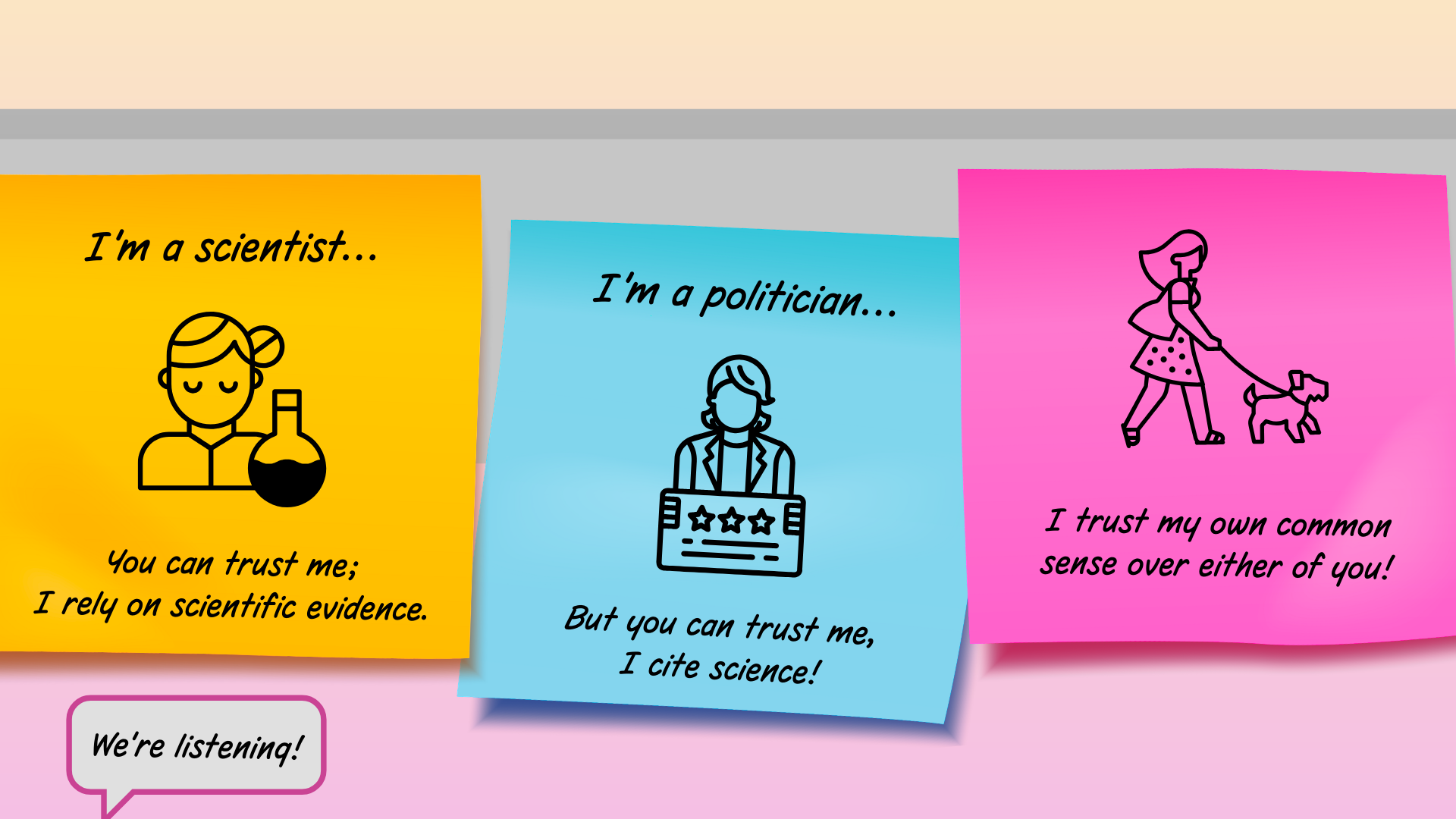
If politicians gain credibility from citing science, scientists shouldn't shy from political topics
Some might say that science and politics mix like oil and water. And yet, it’s incredibly important that politicians inform their decisions with scientific evidence (along with cultural and economic interests), and that scientists ensure their work and findings are accessible to political decision-makers. These days, however, science and politics feel more at odds than ever.
When scientific topics become politicized, scientists and science communicators alike have had the tendency to invoke fighting language: “war on science,” “fighting misinformation,” “anti-science agenda.” And I will admit that in some recent cases, it truly feels that that is the reality. But these metaphors may have negative consequences, and they likely don’t reflect the broader public’s views on science. So who exactly is this language for?
The reality is that science and scientists attract high levels of public trust – something that politicians are often not blind to. While scientists do have room to gain in the “warmth” department of trust, as many studies on trust in scientists have found, it doesn’t change the fact that they fare above average on the trust scale. (Of course, political ideology does impact this trust, likely aggravated by increasing political polarization.)
Yet while most scientists shy away from political topics to preserve their credibility in the public eye (some studies show that political involvement can decrease their credibility), politicians invoke science to enhance their credibility.
“Scientists worry that advocacy may compromise scientific impartiality and invite allegations of biased science and abuse of authority.” — Messling et al. 2025“When politicians cite science, they engage in a process of credibility borrowing, in which the high trust and authority associated with an external source are used to reinforce the credibility of their own message.” — Weisner et al. 2026It’s interesting that both of these could be true at the same time: scientists engaging in politics lose credibility, while politicians engaging in science gain it. Perhaps science’s credibility in the public eye is more resilient than we give it credit for.
In a new preprint study, Daniel Wiesner at the University of Vienna and colleagues investigate how different ways of referring to science in political communication affect perceptions of message and communicator credibility. The researchers used a base message related to the threat of climate change, but varied the communicator, information source (scientific evidence versus appeal to “common sense”), and action recommendation.
They found, unsurprisingly, that “scientists as communicators are perceived as more trustworthy, and their messages are viewed as more credible than those of politicians.” This held true no matter the recommended action in the message. Also, messages citing scientific evidence were rated as more credible, and their communicators as more trustworthy, than messages relying on populist appeals to common sense.
In other words, simply citing scientific evidence can boost politicians' credibility and trustworthiness. There is, however, the caveat that science-populist attitudes changed the game: people with high levels of populist attitudes were more likely to trust a message that referred to “common sense.” But still, cited scientific evidence generally enjoyed high levels of trust and credibility.
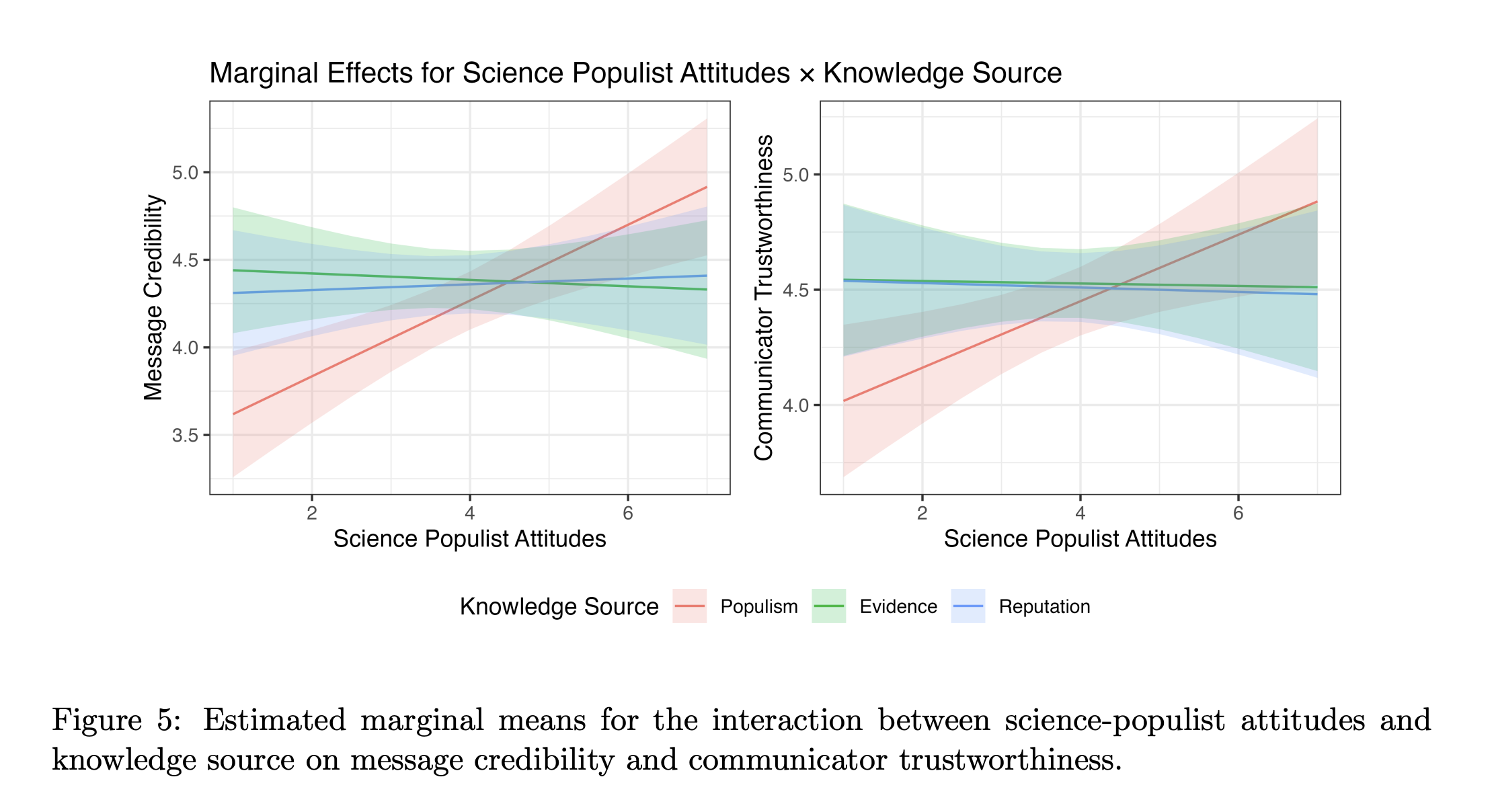
Figure from “Trust me, I cite science” preprint. Messages that use scientific evidence as their knowledge source (green line) “win” at lower levels of science populist attitudes, while appeals to “common sense” or populism win at high levels of science populist attitudes.
Of course, there is some danger to this. If simply citing scientific evidence is effective, politicians could cite evidence that backs their agendas in a misleading way. Maybe this is as good an argument as any for scientists to also get involved in science communication on political topics. If scientists don’t use their science to advocate, someone else might.
“The persuasive power of science references does not, in itself, guarantee their accuracy or honesty, and communication strategies optimized for credibility perceptions could be exploited to lend scientific legitimacy to selective or distorted claims.” — Weisner et al. 2026Intrigued by these findings, I asked Wiesner to answer a few questions about his study… see below!
Q: Can you tell me more about your study and what inspired it?
Wiesner: My research generally revolves around the question of how scientific evidence and expertise are represented in political processes and public discourse. The motivation for this specific study was to find out how such representations of science in politics affect citizens’ perceptions. More specifically, we were interested in how people evaluate the credibility and trustworthiness of science-related political communication.
But I think the broader relevance goes beyond this specific case: at its core, the study asks about the role of knowledge in society and how scientific evidence can (or should) inform decisions. Our study delivers one small piece in that much larger puzzle.
“Ideally, scientific evidence provides the factual foundation for political decisions through evidence-based policymaking. In this view, science serves as a common ground for mutual understanding and offers a shared base of established facts on which political decision-making can build.” — Weisner et al. 2026Q: In your opinion, are there more areas/topics in science politicized today than in past decades?
Wiesner: I am not sure if there are actually more politicized topics today, but there are definitely different ones. This might be driven by an overall shift in attention. While in past decades public discussions often revolved around natural science topics, today we see much more discussions and politicization around topics of social science. And the fact that in these fields there is often not one final answer makes it maybe more contestable and vulnerable to targeted attacks.
Q: What was the most surprising part of this study/findings?
Wiesner: What surprised me the most was that we did not find evidence for substantial science skepticism. Even respondents with what we call higher science-populist attitudes* reported comparable levels of trust with other respondents. The difference was that these respondents trusted “common sense” judgments of ordinary people more than scientific evidence, but they did not really have substantial distrust towards science.
*Science-populist attitudes were measured in the study by level of agreement to statements such as: The people should have influence on the work of scientists; When in doubt, the life experience of ordinary people should be trusted rather than the assessments of scientists; We should rely more on common sense and less on scientific studies; Science has far too much influence on how we should live.
Q: What was the biggest challenge with this study, and how did you overcome it?
Wiesner: The biggest challenge was designing experimental conditions that actually reflected what we wanted to study while still being externally valid. This resembles a classic challenge in social science more generally. In the end, we decided to use fictional social media posts by politicians, because this gave us a controllable and reliable setting. We then varied the political statements, the scientific sources cited, and the decision-making rationales used in the messages.
Q: So, do people trust science communicated by politicians?
Wiesner: They trust it particularly when politicians cite scientific sources. So communicating the factual basis for political decision-making enhances credibility and trustworthiness.
Q: What implications does your study have for how scientists should communicate on science that is potentially politicized?
Wiesner: Scientists do not have to shy away from communicating about political science topics. They are still trusted experts, and communicating about their research and the evidence they have gathered can enhance the credibility of political messages. Interestingly, some of the most trusted messages in our experiment were those communicated by scientists, citing specific evidence, and arguing that decisions were made "for the people." So, if scientists can connect their claims back to everyday life and the interests of ordinary people, that may be especially effective.
Q: But previous studies have found that when scientists get involved in politics or make political recommendations, they lose credibility in the public eye…
Wiesner: We did check this in our data, but did not find support for this specific mechanism.
However, we have to note that our design was not tailored to this specific question. So it could be that the effect is simply small in reality and therefore not observable in our data (since only a third of our stimulus vignettes featured a scientist as the communicator). But I would also agree that there is robust evidence available for this specific effect.
Q: What does science communication mean to you? Why do you think it is important?
Wiesner: Personally, I think that as scientists we should do our best to communicate our findings in a way that is comprehensible to people outside our own field. Science is not detached from society. It is an integral part of it.
Therefore, we should aim to be understood and to be seen as a regular part of society that can provide factual information. Especially in a time where some might feel that factuality is not a thing anymore, in times of hallucinating AI-chat bots and omnipresent misinformation.
Q: What do you think is missing in the communication of science today?
Wiesner: My impression is that science communication does not always think carefully enough about its specific audience. I often come across messages directed at the general public where I ask myself: who, without specific expertise in this field, is supposed to understand this
Thinking about the audience and tailoring key findings in an understandable way, without “dumbing them down,” is very important. But this is not always achieved.
Q: If you could change one thing about how science is communicated today, what would it be?
Wiesner: Science communicators should think more about their audience, and even more importantly, about the everyday lives of their audience. People do not always have the time and energy to engage with multifaceted pieces of scientific information after a hard day at work. So we should break findings down to the key point and, most importantly, explain why this information matters.
I think people are very capable of understanding complex research if we make clear why science matters and how it connects to society.